SpectraPredictions
Spectral Inference - generation of soil property predictions on the fly from locally collected soil spectra using both static national calibration models and optimally determined subsets of national data fused with a local library
The C4S platform provides built-in soil spectral inference tools based on a suite of pre-calibrated vis–NIR predictive models developed from Australia’s national soil spectral library. This library draws primarily on the CSIRO’s Australian National Soil Archive (ANSA) and its associated National soil and site database (NatSoil)(https://doi.org/10.25919/5wm6-xj95), and complemented by additional CSIRO spectral collections accumulated over the past three decades.
These national models enable users to upload their own vis–NIR spectra and instantly obtain predictions for key soil properties, such as soil organic carbon (SOC), pH, cation exchange capacity (CEC), and texture fractions, together with associated measures of predictive uncertainty. The Figure below summarises model performance (based on out-of-bag (OOB) model evaluation, which is used to estimate model performance without the need for a separate validation data set) using the Lin’s concordance (CCC) statistic across 30 soil attributes and 4 different pre-processing approaches designed to accommodate different instrument types and soil conditions. Across most soil attributes including soil carbon, the nationally calibrated models perform strongly, with concordance values typically exceeding a Lin’s concordance correlation coefficient, a common metric of model fitness along the 1:1 line of observations to predictions, of 0.7 across all pre-processing or transformation methods. This value represents a solid alignment between the expected and predicted value for our spectral modelling, and is above the currently accepted benchmark of 0.6 under spectral modelling approaches within the soil carbon farming methods in the Australian Carbon Credit Units (ACCU) program.
The underpinning models use machine learning methods selected for their predictive accuracy, computational efficiency, and ability to capture non-linear relationships. Uncertainty is estimated empirically from the variance among ensemble predictions across trees within each model, providing a practical indicator of confidence for each soil property estimate.
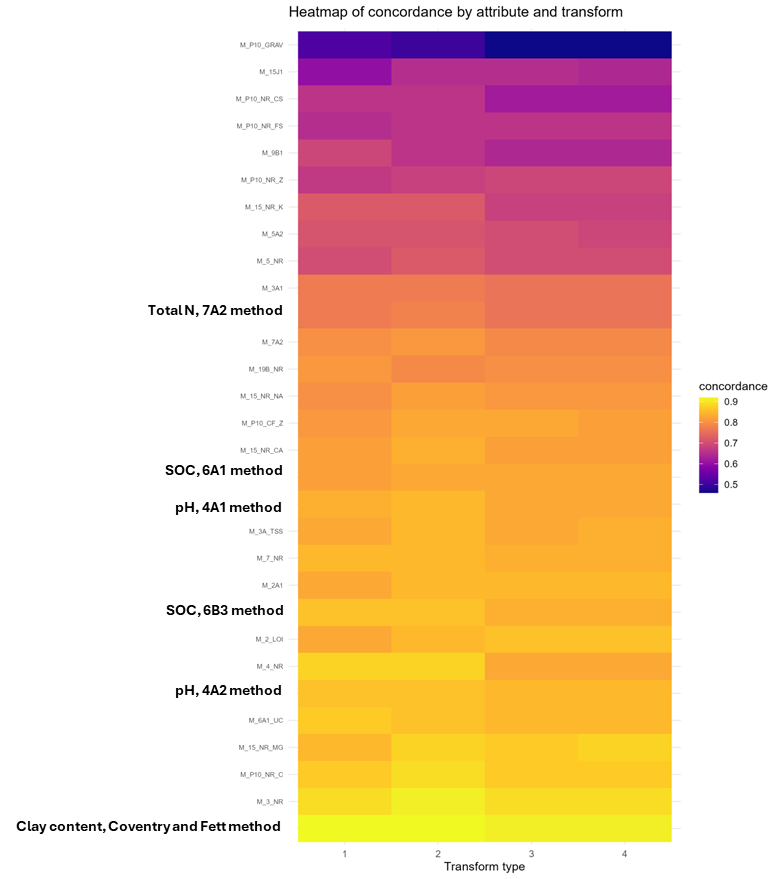
Figure. Model evaluation assessment for national vis-NIR soil spectral prediction models for 30 selected soil attributes. A succinct selection is mentioned as of the method codes provided. Model evaluation is expressed in terms of concordance which measures fidelity between predicted and measured data. A concordance of 1 is high. The accepted benchmark of the ACCU method for SOC is 0.6 for reference (purple colours).
In addition to pre-calibrated national models, C4S supports the creation of localised predictive models that combine user-supplied spectral and analytical data with spectrally similar samples drawn from the national soil spectral library, identified using the selection algorithms described under the Spectra Selection Methods page for sub-setting the national soil spectral archive. Also underpinned by machine learning, these tailored hybrid models improve local relevance while retaining the robustness of nationally representative data. Model performance is assessed using OOB evaluation, providing diagnostic insight into model stability and predictive reliability when independent validation datasets are unavailable.
References:
Moloney JP, Searle R, Malone BP, Dino A, Karunaratne S, Benn D, Stockmann U (2026) The Soil Spectral Selection System: A Practical Platform to operationalise Soil Spectroscopy. Computers and Electronics in Agriculture. Submitted.
Stockmann U, Moloney J, Searle R, Dino A, Malone B, Karunaratne S, Benn D, Glover M, Zhao T (2025) Australia’s national soil spectral library empowering rapid Soil Organic Carbon measurement. End of Project Outcomes Summary Report. Department of Climate Change, Energy, the Environment and Water (DCCEEW) National Soil Carbon Innovation Challenge (NSCIC) Development and Demonstration Grant Round 2 Project SCICDDII000042. CSIRO, Australia.