Optimal Lab Selection
Sample Optimisation
The C4S platform allows users to representatively select samples from a set of soil spectral measurements for conventional laboratory analysis, taking into account also, if desired, the existing national soil spectral library resources. Through selection of samples that represent the greatest spectral diversity, users can improve the predictive capacity and generalizability of their spectral libraries.
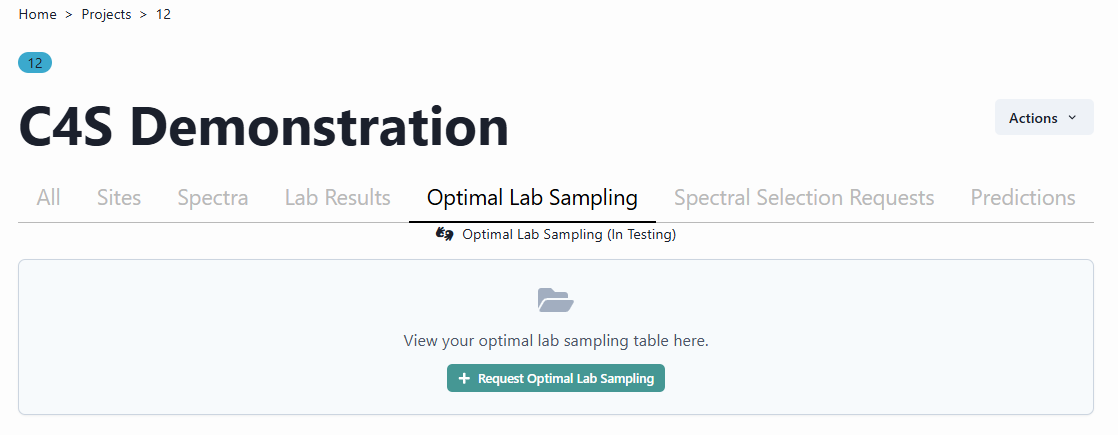
To get started, navigate to the ‘Optimal Lab Sampling’ tab, and the ‘Request Optimal Lab Sampling’ button, as seen below.
The user can then select a soil property and its laboratory method code. For this, only method codes for which the user does not have any existing soil analytical data for can be chosen, as the purpose here is to select samples from their spectral measurements to build a local soil spectral library. In this example for soil organic carbon (SOC), analysed through the 6B1 method - Total organic carbon Walkley & Black wet combustion method (Rayment, G.E. & D.J. Lyons (2011). Soil Chemical Methods - Australasia. CSIRO Publishing). This is then followed by choosing the number of samples the user would like to select to represent the greatest spectral diversity of the local dataset only, or also considering the national library representation for that soil property by selecting a value for the ‘National Fraction’ field. The latter requires a number between 0 and 1. If the value is 0, only the local spectra will be selected from. If the value is 0.3 as in the example below, ~ 1/3 of your target samples would first be selected based on coverage in the national library, and the remaining 2/3 would be selected for coverage within your local set, with consideration of the already selected samples. If the value is 1 all of your samples would be selected based on coverage in the national library.
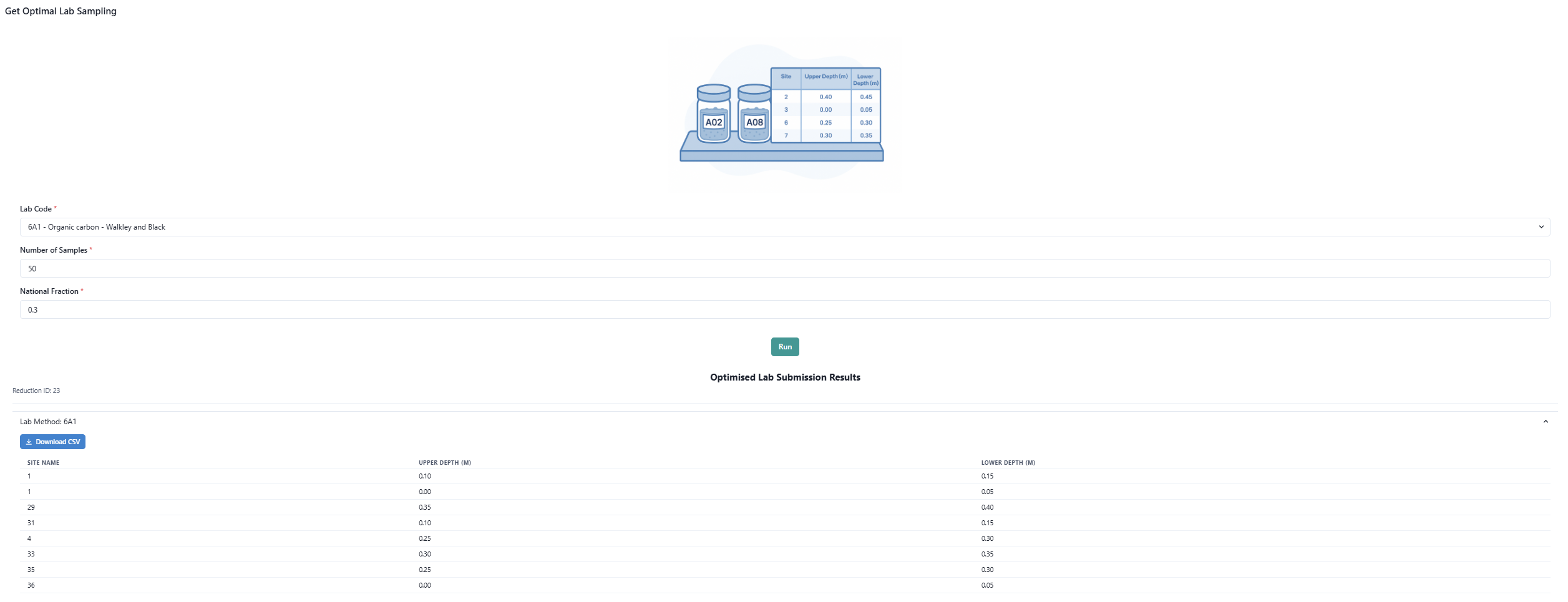
In this case 50 samples were returned to choose for conventional soil laboratory analysis to build a local spectral library, with results downloadable in csv-format.